
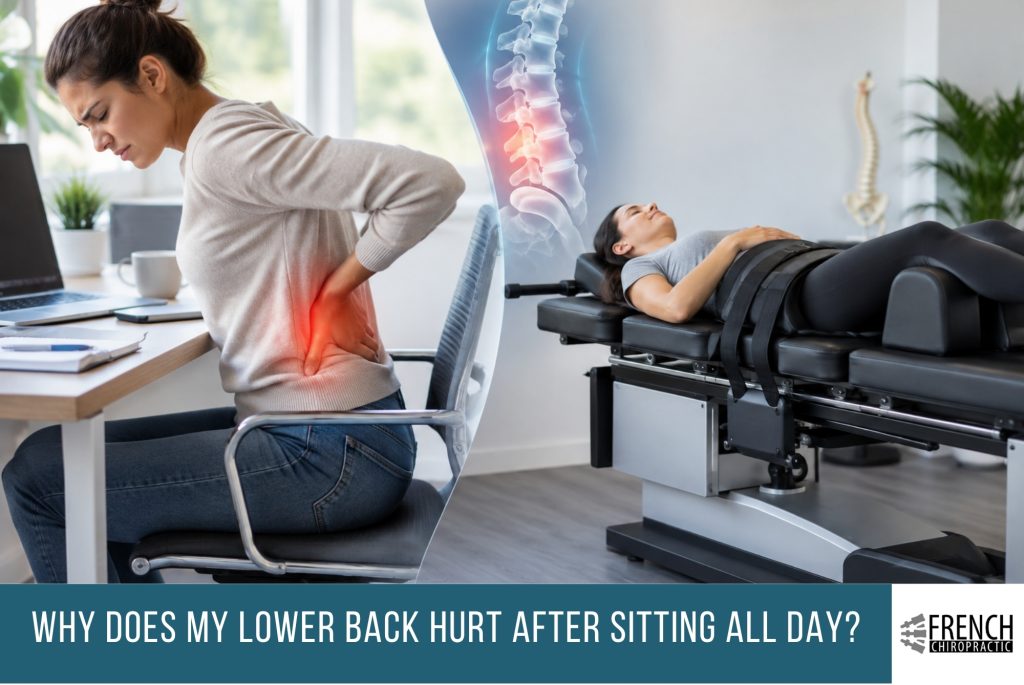
 Sitting may seem like one of the least physically demanding things you do, but spending hours in a chair can place significant stress on the lower back. Whether you work at a desk, commute long distances, spend hours studying, or simply have a sedentary routine, prolonged sitting can contribute to stiffness, muscle tension, spinal compression, and recurring lower back discomfort.
At French Chiropractic in Ventura, California, patients frequently seek chiropractic care because their lower back begins aching after extended periods of sitting. While occasional stiffness may improve after standing and moving around, persistent or recurring pain can indicate that the muscles, joints, discs, or nerves of the lower spine are under excessive stress.
Understanding why sitting affects your back is the first step toward finding an effective solution. For some patients, chiropractic care, movement modifications, and targeted exercises may be appropriate. For others, particularly those experiencing symptoms associated with disc problems or nerve irritation, spinal decompression therapy may be incorporated into a personalized treatment plan.
Why Sitting Can Cause Lower Back Pain
Sitting Changes the Way Your Spine Bears Weight
The lumbar spine—the lower portion of your back—is designed to support the weight of your upper body while allowing movement in multiple directions. Sitting changes the way forces are distributed through this area.
When you sit for long periods, particularly with poor posture, the natural curve of the lumbar spine may flatten. This can increase mechanical stress on the muscles, ligaments, joints, and intervertebral discs.
A few minutes of sitting usually isn’t a problem. The greater concern is prolonged, uninterrupted sitting, especially when combined with slouching, limited physical activity, or an ergonomically poor workstation.
Your Lower Back Muscles Can Become Tired and Tight
Muscles throughout the back and core help stabilize the spine. Remaining in one position for several hours requires certain muscles to maintain low-level contractions for extended periods.
Eventually, these muscles can fatigue. Other muscles may become tight from remaining shortened or inactive.
This can contribute to:
- Aching across the lower back
- Tightness when standing up
- Muscle spasms
- Reduced flexibility
- Difficulty straightening after sitting
- Discomfort that improves temporarily with walking or stretching
Muscle-related pain is common, but it is not the only reason prolonged sitting can become uncomfortable.
How Prolonged Sitting Affects Your Spinal Discs
What Are Intervertebral Discs?
Between the vertebrae of your spine are intervertebral discs. These structures provide cushioning, distribute mechanical loads, and help the spine move.
Each disc contains a softer inner portion surrounded by a tougher outer layer. Healthy discs are remarkably resilient, but they are also affected by age, repetitive stress, injury, genetics, and everyday mechanical forces.
Sitting Can Increase Stress on the Lumbar Spine
Prolonged sitting can increase mechanical loading on structures in the lower back, particularly when a person sits in a slouched or unsupported position.
For someone who already has a compromised or irritated disc, remaining seated may aggravate symptoms.
This is one reason people with certain disc-related conditions frequently report that they feel worse after sitting at a desk or driving for a long time.
Could a Herniated or Bulging Disc Be Causing the Pain?
A bulging disc occurs when a disc extends beyond its usual boundary. A herniated disc occurs when material from inside the disc pushes through or disrupts the outer portion.
Not every disc bulge or herniation causes symptoms. Disc changes are frequently identified on imaging even in people who do not have back pain.
However, when a disc irritates or compresses nearby nerve tissue, symptoms may extend beyond the lower back.
Signs That Your Pain May Involve a Nerve
Symptoms that may suggest nerve involvement include:
- Pain traveling into the buttock or leg
- Burning or electric-like pain
- Tingling
- Pins-and-needles sensations
- Numbness
- Symptoms that worsen after prolonged sitting
- Leg or foot weakness
Sciatica is a commonly used term for symptoms associated with irritation or compression involving the sciatic nerve or the nerve roots that contribute to it.
Because several conditions can produce similar symptoms, an appropriate examination is important before determining the cause.
Poor Posture Can Make Sitting-Related Back Pain Worse
What Happens When You Slouch?
A typical desk posture often involves the shoulders rounding forward, the head moving in front of the body, and the pelvis rotating backward.
As the pelvis rotates, the natural lumbar curve may decrease. The muscles and connective tissues around the spine then have to accommodate this altered position.
Doing this occasionally is unlikely to create a significant problem. Remaining in the position for several hours every day can contribute to cumulative strain.
There Is No Single “Perfect” Sitting Posture
Good ergonomics matter, but even excellent posture does not make sitting indefinitely healthy for your back.
Your body needs movement.
Instead of attempting to maintain one rigid “perfect” posture throughout the workday, regularly changing positions can reduce the amount of time any one area remains under the same mechanical stress.
Why Does My Back Hurt When I Stand Up After Sitting?
Many people notice that their back feels relatively comfortable while sitting but becomes stiff or painful when they initially stand.
This can happen because the muscles, joints, and connective tissues have remained relatively stationary. Your hips may also become tight after prolonged sitting.
The first several steps after standing may therefore feel uncomfortable.
If the stiffness quickly disappears with movement, prolonged inactivity may be a major contributor. If pain persists, becomes increasingly severe, or occurs with neurological symptoms, further evaluation may be warranted.
Your Hips May Be Contributing to Your Lower Back Pain
Tight Hip Flexors and Prolonged Sitting
The hip flexor muscles remain in a shortened position while you sit. Spending much of the day seated may contribute to hip tightness in some people.
When hip mobility becomes limited, movement patterns can change. The lumbar spine may compensate for reduced movement elsewhere.
This is why addressing lower back discomfort often involves evaluating more than the location where the patient feels pain.
Weakness and Deconditioning Can Also Play a Role
A sedentary lifestyle may gradually contribute to reduced strength and endurance in muscles that support the trunk, hips, and pelvis.
This does not mean every person with back pain simply needs stronger abdominal muscles. Lower back pain is multifactorial, and treatment should be based on the individual’s examination and symptoms.
However, appropriate strengthening and regular physical activity can be important components of a long-term back care strategy.
Why Does Driving Make My Lower Back Hurt?
Driving combines several potential triggers for lower back discomfort:
- Prolonged sitting
- Limited ability to change positions
- Repetitive vibration
- Hip flexion
- Poor lumbar support
- Reaching forward toward the steering wheel
- Wallets or objects creating uneven pressure beneath the pelvis
Long-distance drivers may be especially susceptible to sitting-related discomfort.
If possible, taking periodic breaks to stand and walk can help reduce uninterrupted sitting time.
When Lower Back Pain May Be More Than Muscle Tightness
Occasional stiffness after sitting is common. Recurring or persistent pain deserves more attention.
An evaluation may be appropriate if your symptoms:
- Return every day
- Are progressively worsening
- Interfere with work or sleep
- Travel into the buttock or leg
- Include numbness or tingling
- Limit normal activities
- Continue despite changing your workstation or activity habits
- Frequently require medication for temporary relief
The goal is not simply to determine where it hurts. It is to understand why it hurts.
Can Chiropractic Care Help With Sitting-Related Lower Back Pain?
Chiropractic treatment may be considered for certain forms of mechanical lower back pain. The specific approach should depend on the patient’s health history, examination findings, symptoms, and underlying condition.
At French Chiropractic, care can focus on improving spinal function, addressing mechanical restrictions, reducing contributing stresses, and helping patients develop habits that support better long-term mobility.
Treatment recommendations can differ substantially between someone experiencing uncomplicated mechanical back discomfort and someone with suspected disc or nerve involvement.
That distinction is particularly important when considering treatments such as spinal decompression therapy.
What Is Spinal Decompression Therapy?
A Non-Surgical Approach to Certain Types of Back Pain
Non-surgical spinal decompression is a therapy that uses a specialized table or device to apply controlled distraction forces to the spine.
The objective is to gently alter mechanical forces affecting targeted areas of the spine. Depending on the patient’s diagnosis and clinical findings, decompression may be considered as part of a conservative treatment program for certain disc-related and nerve-related conditions.
Unlike surgery, non-surgical spinal decompression does not involve incisions or anesthesia.
Why Decompression May Be Considered for People Who Hurt After Sitting
Not everyone whose back hurts after sitting needs spinal decompression.
However, when prolonged sitting consistently aggravates a condition involving spinal discs or nerve irritation, simply purchasing a new office chair may not address the entire problem.
A chiropractic evaluation can help determine whether the symptoms appear primarily muscular and mechanical or whether there are indications that disc or nerve structures may also be involved.
For appropriately selected patients, spinal decompression therapy may become one component of a broader conservative care plan.
What Conditions May Be Evaluated for Spinal Decompression?
Depending on the individual patient and the cause of the symptoms, a chiropractor may evaluate whether decompression therapy is appropriate for conditions associated with:
- Herniated discs
- Bulging discs
- Disc-related lower back pain
- Certain forms of sciatica
- Degenerative disc changes
- Nerve irritation or compression
- Chronic mechanical lower back pain
Spinal decompression is not appropriate for every patient or every spinal condition. A proper evaluation is essential before beginning treatment.
What Does Spinal Decompression Feel Like?
During non-surgical spinal decompression, the patient generally lies on a specialized table while controlled forces are applied to targeted areas of the spine.
Treatment settings can be individualized according to the patient’s condition and tolerance.
Many patients find the process comfortable, although individual experiences vary. A treatment plan may also incorporate chiropractic care, mobility exercises, strengthening, ergonomic changes, or other conservative strategies when appropriate.
What Can I Do During the Workday to Reduce Lower Back Pain?
Take Regular Movement Breaks
One of the simplest strategies is to avoid remaining seated continuously for hours.
Periodically stand, walk, stretch, or change positions. Even short movement breaks can interrupt prolonged static loading.
Improve Your Workstation
Consider the position of your:
- Chair
- Computer monitor
- Keyboard
- Mouse
- Desk
- Feet
- Lumbar support
Your workstation should allow you to work without constantly reaching, twisting, leaning forward, or looking downward.
Keep Your Feet Supported
Your feet should generally rest comfortably on the floor or an appropriate footrest. Sitting with the feet unsupported may contribute to an unstable or uncomfortable posture.
Position Your Monitor Appropriately
A monitor that is too low or too far away may encourage you to lean forward throughout the day.
Adjust the screen so you can view it comfortably while maintaining a relaxed position.
Alternate Between Sitting and Standing
A sit-stand workstation can be useful, but standing all day is not necessarily the solution either.
The objective is movement and variation, not simply replacing eight hours of sitting with eight hours of standing.
Stay Physically Active Outside of Work
Walking, resistance training, mobility exercises, and other appropriate physical activities can help maintain strength, endurance, and movement capacity.
The best exercise program depends on your health, fitness level, and underlying spinal condition.
When Should I Seek Immediate Medical Attention for Back Pain?
Most lower back pain is not a medical emergency. However, certain symptoms require prompt medical evaluation.
Seek urgent medical attention if back pain occurs with symptoms such as:
- New loss of bowel or bladder control
- Numbness around the groin or saddle area
- Significant or rapidly worsening leg weakness
- Severe pain following substantial trauma
- Fever or other signs of serious illness accompanying back pain
These symptoms should not be managed solely with home care or routine chiropractic treatment.
Why Identifying the Cause Matters
Lower back pain is a symptom, not a diagnosis.
Two people may both say, “My back hurts after sitting,” yet have very different underlying problems. One person may primarily have muscular fatigue and poor movement habits. Another may have a disc-related condition that becomes aggravated in prolonged seated positions.
Effective care begins with determining which structures and movement patterns are likely contributing to the symptoms.
At French Chiropractic, the goal is to evaluate the individual rather than apply the same treatment to every person with lower back pain. When clinically appropriate, that treatment plan may include chiropractic care, lifestyle and ergonomic recommendations, therapeutic exercises, and non-surgical spinal decompression therapy.
Frequently Asked Questions About Lower Back Pain From Sitting
Why does my lower back hurt only when I sit for a long time?
Prolonged sitting changes spinal loading and keeps the hips, muscles, and joints relatively stationary. Poor posture, muscular fatigue, disc irritation, and existing spinal conditions may all contribute. If symptoms repeatedly occur after sitting, an evaluation can help identify the likely cause.
Can sitting all day cause a herniated disc?
Disc herniation usually cannot be attributed to one activity alone. Age-related changes, genetics, repetitive mechanical stress, injuries, and other factors may contribute. Prolonged sitting—particularly in sustained flexed postures—may aggravate symptoms in someone who already has a disc problem.
Why does my lower back feel better when I walk?
Walking changes the mechanical demands placed on the spine and activates muscles that remain relatively inactive while sitting. Movement can also decrease stiffness. However, symptom patterns vary according to the underlying condition.
Is a standing desk better for lower back pain?
A standing desk can help reduce uninterrupted sitting, but standing continuously can create its own discomfort. Alternating between sitting, standing, and walking is generally more useful than remaining in any single position for an entire workday.
How often should I get up from my desk?
There is no universal interval that works for everyone. In general, avoid sitting uninterrupted for prolonged periods. Short, frequent movement breaks can be easier to incorporate into a workday than waiting until your back becomes painful.
Can poor posture cause lower back pain?
Posture can contribute to mechanical stress, especially when the same position is maintained for hours. However, back pain usually has multiple contributing factors. Movement habits, physical conditioning, previous injuries, disc health, work demands, sleep, and other factors can also influence symptoms.
Does lower back pain after sitting mean I have a bulging disc?
No. Muscle fatigue, joint stiffness, hip tightness, and other mechanical issues can cause similar symptoms. Disc abnormalities also do not always cause pain. An examination is needed to determine whether a disc may be contributing.
What are signs that my lower back pain may involve a nerve?
Pain traveling into the buttock or leg, numbness, tingling, burning sensations, or weakness can indicate possible nerve involvement. These symptoms warrant an appropriate clinical evaluation.
What is the difference between chiropractic adjustment and spinal decompression?
Chiropractic adjustments and spinal decompression use different mechanical approaches. Chiropractic adjustments generally address joint mobility and spinal mechanics, while non-surgical decompression uses controlled distraction forces. Depending on the patient’s condition, one or both approaches may be considered as part of a treatment plan.
Is spinal decompression the same as traction?
They are related concepts because both involve distraction forces, but modern spinal decompression systems may use specialized equipment and adjustable treatment protocols designed to target specific spinal regions. The exact equipment and method can vary.
Does everyone with lower back pain need spinal decompression?
No. Spinal decompression is not necessary or appropriate for every case of lower back pain. Treatment should be based on an evaluation, diagnosis, health history, and individual clinical findings.
Can spinal decompression help a bulging or herniated disc?
Non-surgical spinal decompression may be considered as part of conservative management for selected patients with disc-related symptoms. Results vary, and suitability depends on the patient’s specific condition.
Can I receive spinal decompression if I have sciatica?
Some cases of sciatica are associated with disc or spinal conditions for which decompression may be considered. However, sciatica has multiple possible causes, so identifying the source of nerve irritation is important before selecting treatment.
How many spinal decompression sessions will I need?
There is no appropriate universal number of treatments. Recommendations depend on the patient’s diagnosis, severity and duration of symptoms, clinical response, overall health, and treatment goals.
Should I see a chiropractor if my back hurts every day after work?
Recurring pain is a reasonable reason to seek an evaluation, particularly when it is affecting your work, exercise, sleep, or normal activities. Determining why the symptoms keep returning can help guide a more targeted treatment strategy.
Stop Letting Your Desk Control How Your Back Feels
If you regularly finish the workday with an aching or stiff lower back, don’t assume that discomfort is simply something you have to accept because you work at a desk.
Changing your workstation and moving more frequently are important first steps, but recurring symptoms may warrant a closer look at your spinal mechanics, discs, nerves, muscles, and movement patterns.
French Chiropractic in Ventura can evaluate your lower back symptoms and determine which conservative treatment options may be appropriate. For patients whose symptoms are associated with certain disc or nerve-related conditions, non-surgical spinal decompression therapy may be considered as part of an individualized treatment plan.
Contact Information
French Chiropractic
3242 Telegraph Rd
Ventura, CA 93003
Phone: (805) 253-2225
Website: Frenchfamilychiropractic.com
Appointments: frenchchiropracticventura.com/appointments/